Search Intent: How to Match Content to What People Actually Mean
On this page
Search intent is the purpose behind a query.
It’s the difference between someone who wants a definition, someone who wants reassurance, and someone who’s ready to contact an adviser even if the words they type look similar.
For SEO, intent matters because Google rewards pages that best satisfy what the searcher is trying to do. If you mismatch intent, you can target the right keyword and still attract the wrong visitor, or rank briefly and fail to convert.
In UK financial advice, intent matching matters even more because the journey is trust-led: people move cautiously, credibility signals carry weight, and overly sales-driven language can create friction (and sometimes risk).
- People move slowly and cautiously
- Trust signals matter as much as information
- Sales language creates friction (and sometimes risk)
- Many searches are driven by uncertainty, not urgency
This page explains the main types of search intent, how to identify intent from search behaviour (and SERPs), and how to design content that fits each stage using examples from the adviser SEO topics covered across this site.
By the end, you’ll be able to classify intent quickly, spot mixed-intent SERPs, and choose the right page type (and internal links) for each query.
What search intent actually means
A query is just the words.
Intent is what the person is really trying to achieve.
For example:
- “financial adviser fees” is not necessarily price-shopping, it’s often uncertainty and risk-reduction: “How does this work, and is it worth it?” Users may be looking to understand value as much as they are seeking to compare costs.
- “financial adviser near me” is usually action-oriented: “Show me real options I can evaluate right now.”
- “chartered financial adviser” is often validation-oriented: “How do I filter for credibility?” (and “chartered” means something specific, not a generic superlative)
SEO goes wrong when we treat all of these as the same “keyword problem”.
The 4 core types of search intent
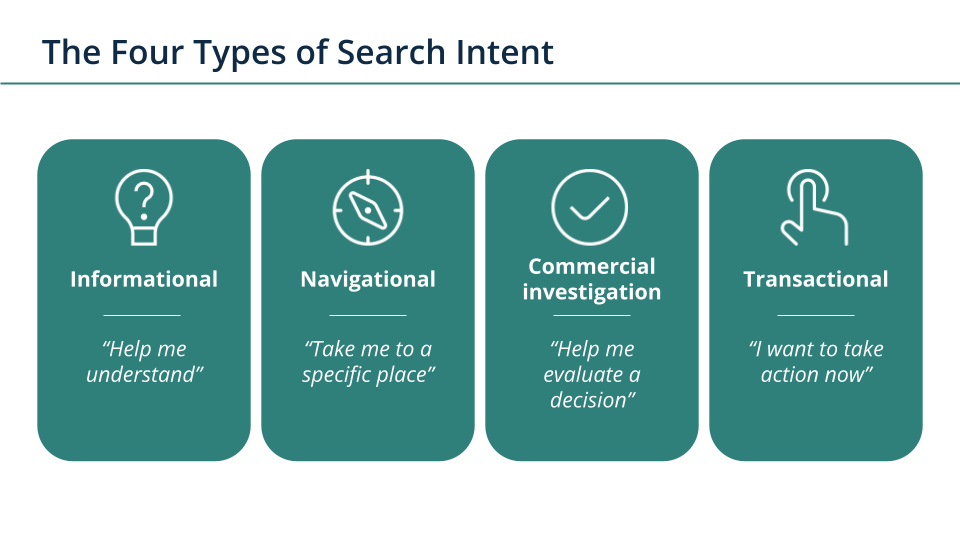
Most SEO frameworks group intent into four buckets:
- Informational
- Navigational
- Commercial investigation
- Transactional
These are useful because they map to different page formats, different content depth, and different expectations in the search results.
1) Informational intent: “Help me understand”
This is learning, clarifying, comparing concepts, or building confidence.
Typical modifiers:
- what is, how does, guide, explain, difference between, pros and cons, does it matter
My page on understanding how Google works is classic informational intent.
For a financial advice site, pages explaining issues like drawdown vs pension or platform fees vs fund charges would be ideal informational content.
How people choose a financial adviser online sits in this space too: it helps someone understand the decision process and what signals people look for.
What Google tends to reward here: clarity, completeness, and “this answered my question” satisfaction, not persuasion.
2) Navigational intent: “Take me to a specific place”
This is when the searcher already knows the destination (brand, site, person) and is using Google like a navigation bar.
Examples:
- “FCA register [firm name]”
- “[adviser name] reviews”
- “PADigital financial adviser SEO”
These queries often don’t need long content. They need:
- the right page to exist
- to be crawlable/indexed
- to be clearly labelled (titles, headings, internal links)
You can’t manufacture navigational intent, but you can make sure Google can reliably return the right page when it exists.
3) Commercial investigation: “I’m getting close, help me evaluate”
This is the “almost ready” phase. People are comparing options, checking credibility, and reducing perceived risk.
This is where many financial advice searches sit.
How it differs from transactional in advice.
- Transactional = “find an adviser”
- Commercial investigation = “reduce risk before choosing”
Examples:
- Fees and charging structure queries (value + trust + process)
- Qualification and status signals (“chartered”, “regulated”, “independent vs restricted”)
- “SEO for IFAs” style searches on this site (which supports a professional buyer evaluating a supplier, not a casual learner)
Commercial investigation content should usually:
- explain trade-offs
- clarify how decisions are made
- set expectations
- avoid hype
You can often improve pages which target commercial intent by making sure they include:
- clear explanations of process (what happens next)
- trust validation paths (how to check FCA register / credentials)
- realistic ranges or drivers of cost (without quoting misleading “from” prices)
- plain-English trade-offs (“when ongoing makes sense / when one-off makes sense”)
It’s persuasive by being precise, not by “selling”.
4) Transactional intent: “I want to do something now”
This is the action stage: enquire, book, call, get a quote, find a provider.
In financial advice, transactional intent often shows up as:
- “financial adviser near me” seaches (strong local + action signal)
- “independent financial adviser [town/city]”
- “retirement planning adviser [location]”
For these, Google tends to rank pages that prove:
- legitimacy (real business, real location)
- relevance (services match query)
- trust (consistency, reviews, signals)
And users expect fast validation: “Are these real, are they credible, are they local, what do they do?”
Intent is not a funnel. It’s a set of jobs-to-be-done
A common mistake is treating intent as a neat staircase: informational > commercial > transactional.
Real journeys are messier, especially in regulated categories.
Users might:
- search “near me” (action)
- then search “fees” (uncertainty)
- then search “chartered” (validation)
- then read “how to choose” (reassurance)
- then go back to local results
That’s why a content strategy for financial advisers works best as a connected cluster, not isolated pages.
How to identify intent from the SERP
If you want to diagnose intent properly, don’t guess from the keyword alone. Use a consistent set of checks.
1) Look for format patterns in the top results
Ask yourself: what kind of pages are ranking?
- Guides and definitions suggest informational content
- Lists of providers + maps suggest transactional or local content
- Comparison pages, “best”, “cost”, “reviews” suggest commercial investigation
- Brand homepages and specific pages suggest navigational content
Google’s ranking systems are designed to prioritise content that helps users complete their task (not content that merely targets a phrase).
2) Look at SERP features
Certain features often indicate intent:
- Map pack > local action intent
- People Also Ask > informational / uncertainty
- Review stars > evaluation intent
- “Things to know” / explanatory panels > informational
Heavy ad presence can indicate transactional value, but in advice it’s often mixed and cautious. In UK financial advice SERPs, intent is often mixed. Even action-sounding queries can include reassurance and credibility checks.
3) Check the language of the query itself
Some modifiers are unusually diagnostic:
- “near me”, “[location]” > local intent
- “cost”, “fees”, “worth it” > evaluation under uncertainty
- “chartered”, “FCA authorised”, “regulated” > trust validation intent
- “how does”, “what is” > learning intent
4) Watch for mixed intent
Some queries produce blended results because different groups of searchers mean different things.
A classic example in advice is “financial adviser fees”:
- some want charging models explained
- some want ballpark figures
- some want reassurance and fairness
- some are comparing advisers
Matching intent to the right page type
This is where “expertise” shows up, because good intent-matching is mostly content design, not “keyword placement”.
Informational pages: build understanding and confidence
Good informational pages:
- teach clearly
- define terms
- answer follow-up questions
- avoid pushing a conversion too early
Commercial investigation pages: reduce perceived risk
These pages win by being:
- accurate
- balanced
- easy to validate
- aligned with how professionals actually behave
Transactional/local pages: prove legitimacy fast
Transactional pages (especially local intent) should:
- make the service obvious
- make the “real business” signals obvious
- connect to supporting trust content via internal links
Common search intent mistakes (and what to do instead)
- Don’t: Write one page to target multiple intents.
- Instead: Split pages and use supporting internal links
- Don’t: Treat “fees” as price-shopping only.
- Instead: Reassure your reader, explain your value and document your process
- Don’t: Make your local pages too informational.
- Instead: Move education to supporting pages and keep local pages validation-first
- Don’t: Publish “lead magnet” content that looks like sales copy.
- Instead: Reduce claims and increase clarity around the services you offer
Why intent matching matters more in financial advice than most industries
In many markets, the primary conversion lever is urgency.
In advice, it’s trust + perceived risk.
That changes what “helpful” looks like:
- A pushy page can rank (briefly) but still leak conversions through mistrust
- A cautious, clear page can convert later because it supports the decision journey
- A “lead magnet” style approach can actively reduce confidence (especially on sensitive queries like fees)
That’s also why “people-first” guidance is especially relevant in YMYL-adjacent areas: the goal is to help users make informed decisions, not to manipulate them.
A simple intent model you can use for adviser SEO planning
If you want something repeatable, use a three-layer model and map pages into it:
1) The uncertainty layer (informational)
Goal: explain concepts and reduce confusion.
Examples:
- how search works
- how people choose
- core definitions
2) The validation layer (commercial investigation)
Goal: help people filter and evaluate.
Examples:
- fees structures and what affects cost
- credentials and regulatory status
- independent vs restricted clarity
3) The action layer (transactional/local)
Goal: help people find, shortlist, and take a next step.
Examples:
- “near me”
- location service pages
- enquiry-ready “what we do” pages
The SEO win is not simply having one of each type, it’s connecting them so the entire user journey is supported.
Conclusion
Search intent is the difference between publishing content and publishing the right content.
If you’re building SEO for a regulated advice firm, the goal isn’t to chase keywords — it’s to match real decision-stage needs with clear, compliant pages that support trust.
If you want a structured view of how this fits together across your site, continue to Financial Adviser SEO Strategy, then review Local SEO to understand how the clients closest to you can find you.
FAQ
What’s the difference between commercial and transactional intent?
Commercial investigation intent is evaluation. The searcher is close, but not ready to act. They’re trying to reduce risk, understand trade-offs, and decide who or what is worth shortlisting.
Transactional intent is action. The searcher wants to do something now: contact, book, get a quote, find a provider, visit a location, and so on.
In UK financial advice, many “action-sounding” queries still carry evaluation needs because trust is part of the job. Someone can be “near me” and still require reassurance before they’ll enquire. That’s why supporting pages (fees, credentials, how-to-choose) matter so much.
Can one keyword have multiple intents?
Yes, and this is one of the most common reasons pages underperform.
A single query can have:
- Different intents for different users (mixed audience intent)
- Multiple intents for the same user (they’re doing more than one job at once)
- A blended SERP because Google is trying to satisfy several interpretations
- Example: “financial adviser fees” can mean:
The practical takeaway: don’t decide intent from the keyword alone. Decide it from the SERP pattern and the job the content needs to do. If the SERP is clearly mixed, you either:
- create a page that satisfies the dominant intent and includes a short section for the secondary need, or
- split into separate pages and link them together (this is often the cleaner long-term option).
How do I choose the right page type for a query?
Use a simple 4-step method:
1) Start with the SERP, not your assumptions. Search the term and ask: what is ranking?
- Guides, definitions, explainers → informational page
- Brand pages, specific firms, FCA register results → navigational page
- “Best”, “cost”, “reviews”, comparisons → commercial investigation page
- Map pack + directories + local firms → transactional/local page
2) Identify the dominant “job to be done”. What does the searcher need to complete?
- Understand → explainers, FAQs, examples
- Evaluate → trade-offs, credibility, what affects outcomes/cost
- Act → contact pathways, service clarity, proof of legitimacy
3) Match the page format to that job
- Informational: structured guide, definitions, examples, FAQs
- Commercial: comparison framing, “what to look for”, evaluation criteria, reassurance
- Transactional/local: service page + location signals + next step
4) Handle secondary intent with structure, not confusion. If there’s a secondary intent, add a clearly-labelled section like:
- “If you’re comparing advisers…”
- “If you’re ready to speak to someone…”
…and link to the best-fit page for that next stage.
This keeps one page from trying to be everything which is a common cause of weak rankings and weak conversions.
Should I create separate pages for “fees” and “cost”?
Often, yes, but only if the SERPs (and user expectations) are meaningfully different.
Here’s how to decide:
Create separate pages if:
- The SERP for “fees” is dominated by how advisers charge (structures, % vs fixed vs hourly, ongoing vs one-off), while “cost” is dominated by how much does it cost (ranges, examples, affordability).
- You find yourself forcing one page to answer two different questions:
- “How does charging work?” (fees)
- “What might I expect to pay?” (cost)
Keep one page if:
- The SERPs are essentially the same, with the same types of pages ranking.
- You can satisfy both needs cleanly with strong sectioning:
- H2: “How financial adviser fees work”
- H2: “What affects cost (and why prices vary)”
- H2: “How to compare value, not just price”
A practical compromise that works well in advice:
- One main page targeting the broader topic (often “fees”), with a dedicated section for “cost”.
- If “cost” demand grows, spin it out later into its own page and keep the original section as a summary + internal link.
That approach avoids thin-content duplication while still allowing you to match intent as the site matures.
How does intent affect internal linking?
Internal linking works best when it mirrors the way users actually move between intents.
Think of internal links as intent pathways:
1) Informational → Commercial (build confidence into evaluation)
- From explainers, link to pages that help users apply the knowledge and evaluate options.
- Example links: “fees”, “how to choose”, “chartered & regulated”, “IFA vs restricted”.
2) Commercial → Transactional (evaluation into action)
- From evaluation pages, link to the next action stage.
- Example links: “near me”, location pages, “work with us”, contact.
3) Transactional → Validation (prevent drop-off at the last moment)
- From local/action pages, link back to trust pages for reassurance.
- Example links: “fees explained”, “how to choose”, “regulated/chartered”.
4) Keep anchors intent-specific
- Avoid generic anchors like “learn more”. Use anchors that tell the reader what problem the next page solves:
- “How adviser fees work”
- “What ‘chartered’ means in practice”
- “How people choose an adviser online”
- “Near me searches and local intent”
Why this matters for SEO
Internal links help search engines understand:
- which page is your best answer for a topic (topical focus)
- how pages relate (cluster structure)
- which pages are more important (internal authority flow)
But the real win is user experience: intent-aligned links reduce friction and help people progress naturally. This is especially important in financial advice, where reassurance is part of conversion.